 Psychotherapist and counsellor Duncan E. Stafford suggests his professions speak readily of technique, theory and evidence, but less often of loving, attentive presence. Tracing its echo across generations, he argues this quality is passed from therapist to therapist through relationship, shaping practice more deeply than theory alone.
The psychotherapy and counselling professions often speak about technique, theory and evidence. Less often do they speak about loving, attentive presence. Yet if we trace its echo through the generations, we begin to see how this way of being with another person is quietly handed on through relationship rather than instruction – and how it may shape therapists more deeply than any theory ever could.
It is a hot June day in Cambridge. Really hot – touching 30 degrees C. The kind of heat that feels slightly out of place in the UK, as though the weather has arrived and landed from somewhere else.
We are still, in some ways, getting used to living in a new century. The year 2001 remains a hint of the future for those of us born in the 1960s. But this is no Space Station V, the futuristic, rotating space station of Stanley Kubrick’s film (1968).
I am in “the box” with my Jungian analyst. Session one of three this week. And, strangely enough, we are talking about space.
Back in my 1960s childhood, the space race mattered. The moon landing of 1969 carried a kind of collective magic. I remember my confusion, trying to work out something that felt, at the time, like a straightforward question: If human beings can travel to the moon, why hadn’t we yet discovered where heaven is?
And if we couldn’t find heaven, where did that mean my beloved Uncle George was, now he’d died, leaving me feeling abandoned aged just six.
Neither then nor now were these scientific questions. They were questions of curiosity that had borrowed thinking from science because there was nowhere else apart from theology to put them.
These were questions about loss.
About absence.
A young child’s existential dissonance while seeking to understand what “afterhere” is when “here” ends.
Eric is eighty years old. I would only discover after his death in 2009 that he had recently retired. For now, I am his last long-term patient, and he is the wise old soul sitting opposite me in “the box” – listening, thinking, allowing things to take the time they need. An intellect, but oh so human with it. I would dub Eric, in the room with him, “my therapy George” and I felt something incarnate of George’s love throughout my six years of work with Eric.
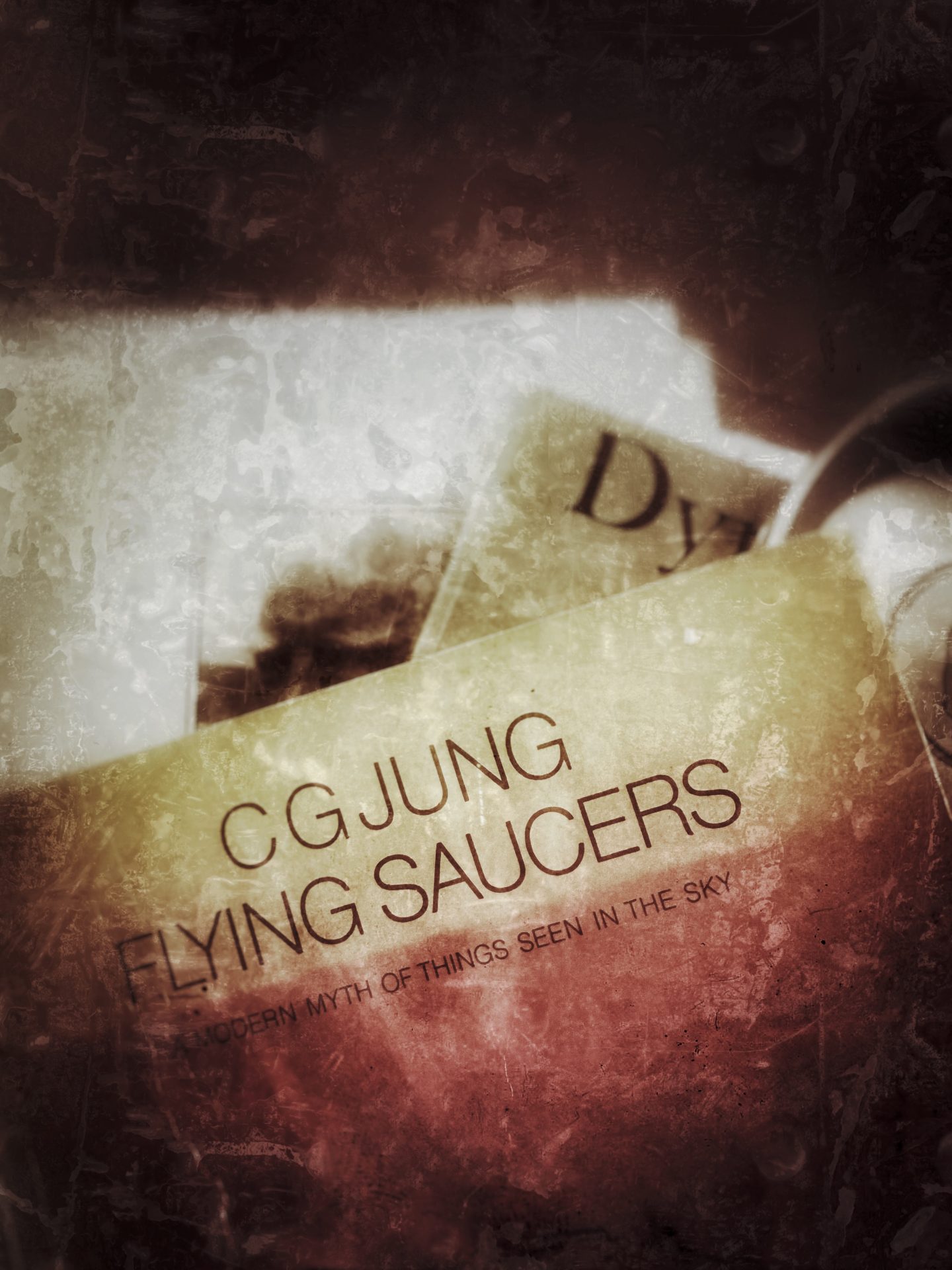
We find our way to Jung and his essay Flying Saucers: A Modern Myth of Things Seen in the Skies.
“Jung suggests that the circular flying saucer image resembles the mandala,” Eric says. “A symbol of wholeness emerging from the unconscious.”
“And it appears during the anxieties of the Cold War?” I ask.
“Yes,” he responds. “As an expression of humanity’s longing for order, meaning and salvation.”
The question of whether UFOs are physically real is not Jung’s primary concern. What interests him is what human beings make of them. What is seen. What is imagined. What rises up from somewhere less visible.
The sky becomes a surface.
A place that things are projected onto.
The unknown becomes somewhere we look – not just for answers, but for ourselves.
There is something about these sessions that feeds me in a way I don’t fully understand at the time. Partly it is Eric himself: he listens so intently, eyes often closed as though drawing the images that you speak into his own inner world. There is a sense, sitting with him, of a life that has moved across very different worlds.
War.
Aftermath.
Theology.
Analysis.
He does not present these as stories. They are simply there, somewhere in the background of how he listens.
I will later learn more. World War Two, The Royal Canadian Navy. Signals and cyphers. Atlantic convoys. D-Day. Auschwitz in 1949. The International Labour Office. Union Theological Seminary. Psalm 51: “Thou requirest truth in the inward parts.”
Paul Tillich suggests Eric's analysis. First in, New York: Freudian, through a direct analysand of Freud. Later London: ten years Jungian analysis and training with Gerhard Adler.
But none of this is how it arrives in the room.
What arrives is a way of listening.
A particular kind of attention.
Something that feels both grounded and open at the same time. The human and the professional, one filtered through the other.
And gradually it becomes clear that this is not just personal. It has been passed on.
One person listened.
Something shifts.
Another person listened.
The shift becomes part of them.
Another listens, and finally it is my turn.
I listen …
I sit opposite someone else.
They listen.
Something shifts again.
That shift is carried forward.
Offered again.
Changed again.
This is relational inheritance.
Not the passing on of ideas alone, but of a way of meeting experience. A way of staying with what is not yet understood. A way of allowing meaning to emerge rather than forcing it into place.
In this space I am learning more about my craft as a therapist myself than any book, course or training will ever teach me.
Eric has inherited something from his analysts. He has lived it, altered it, made it his own. And now, sitting with him, I am encountering it – not as theory, but as something happening between us.
Not an answer.
Not an interpretation.
A way of paying attention.
Perhaps that is what the conversation about space is really circling around. We are not looking for heaven in any literal sense. Nor are we trying to resolve the reality of UFOs.
We are circling the question of how human beings live with what they cannot locate.
On the many laps around my own traumas, Eric gradually facilitates, teaches me that they are not circles but spirals. A circle returns to the same place. A spiral returns to the same place, but at a different depth. That, I begin to understand, is how healing unfolds. Perhaps it is also how inheritance happens.
References
Jung, C. G. (1959). Flying Saucers: A Modern Myth of Things Seen in the Skies (trans. R. F. C. Hull). Routledge & Kegan Paul.
Kubrick, S. (Director) (1968). 2001: A Space Odyssey. Metro-Goldwyn-Mayer.
________________
Return to THE NOOK
All rights reserved © Copyright Duncan E. Stafford 2026. Unauthorised use and/or duplication of this material without express and written permission from the author of this post is strictly prohibited. Author contact via website Contact page. Website version and image © Copyright Therapy Place Bristol 2026. Article published July 2026